Connecting Scriptures: Genesis 17:1, John 1:51f, Matthew 7:7-11, Psalm 50, Romans 11:34-36
It was decided, Jacob would leave his family and land of promise. Isaac gives Jacob a second blessing, like a benediction, more directly passing on the Abrahamic covenant. This son who deceived him, and took what Isaac believed should have been Esau’s, was leaving with specific orders to find a wife in the land of Rebekah’s family. Notice that Issac is willing to send Jacob out of the promised land, unlike his father Abrahams actions when he was seeking a wife for him. I think you can see that Abraham understood the importance of staying where God had led him, whereas Isaac seems to have a disconnect with his part in the promise. He is living in the blessing, but unable to pass down a real relationship with the LORD. I think we have seen that in the actions of the two sons and all the “works” they perform to seek for approval, instead of simply seeking God and worshipping Him. In a step in that direction to earn favor, Esau observes the blessing and “goodbye” of Jacob. Perhaps trying to salvage some sort of blessing for himself by seeking a wife that his parents may approve of, he travels in the direction of the other half of his family tree, seeking Ishmael and his daughter Mahalath.
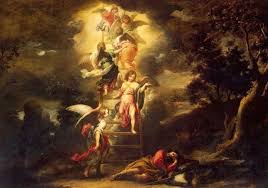
Jacob, after obeying his parents to the letter, is now on the move, and the LORD intends to meet with him in a far away place. Not because of anything good in him, we can already see that Jacob is a sinner full of deceit and self preservation. He is determined and very motivated to make a name for himself, taking whatever enemies that earns along the way. This is the man God chooses to give a dream to. God coming to Jacob on a pillow of stone, is grace. He lays down his head and sees the LORD standing above him and angels coming down to earth. This was a place where God was. A place where His glory was touching down for a purpose. God graciously assures Jacob who He is—the God of Abraham your father, and Issac. I think that description is a telling one. He is highlighting the father he should emulate, the faith of Abraham who was considered God’s friend. He promises Jacob land and that He would be with him. He would bless him with a lineage. Most importantly, he assures him that He would bring him back to the land of promise. Because leaving the land was not ideal! Maybe this concept hadn’t crossed Jacobs mind. The fact that God was going to bring him back and have His presence with him was huge!
Jacob awakes and builds a pillar on the stone he slept on. His response was fear and intrigue. What God showed him didn’t really change his character, but it would put him on the right track to see that God was inviting him into a relationship, not merely a God who would bless and curse. He anoints the place and calls it Bethel—the house of God. As if to say, “This is a bookmark of faith. This is where God is.” But, did he believe God would go with him? What comes next seems like classic Jacob behavior. Lets make a deal with God! If you will do this, I will do this. God already promised land, lineage and blessing and Jacob asks for the most basic things: comfort, protection in travel, food and clothes. But, maybe it was more of a vow of his intentions, and a hope for the desires of his heart. Which are desires we all have: we want to be safe, we want to be provided for, and we want to know where we are going. Where is this road really leading us? As messed up as Jacob had made his life, I am not far from Jacob. I have made vows and deals with God, and upheld my part—for a season. God in his immense patience and knowing “where the road is leading”, holds all the promises and needs no proof from us to keep them. Praise God.
Questions for Reflection:
1. What do you think the ladder in Jacob’s dream represents and how does it connect with God’s relationship and intentions to humanity?
2. Jacob had been passed down a lineage, which he was just now seeing his part in. Why is it important to make our faith “our own” and what are the dangers of depending on another’s faith for our growth?
3. Have you had a “Bethel” encounter with God? A time when you knew you had encountered the presence of God?

 thelifeabundant.org